Selenium Alternatives
Playwright, Cypress, Puppeteer and no-code platforms compared — what each is good at, and what migration actually costs.
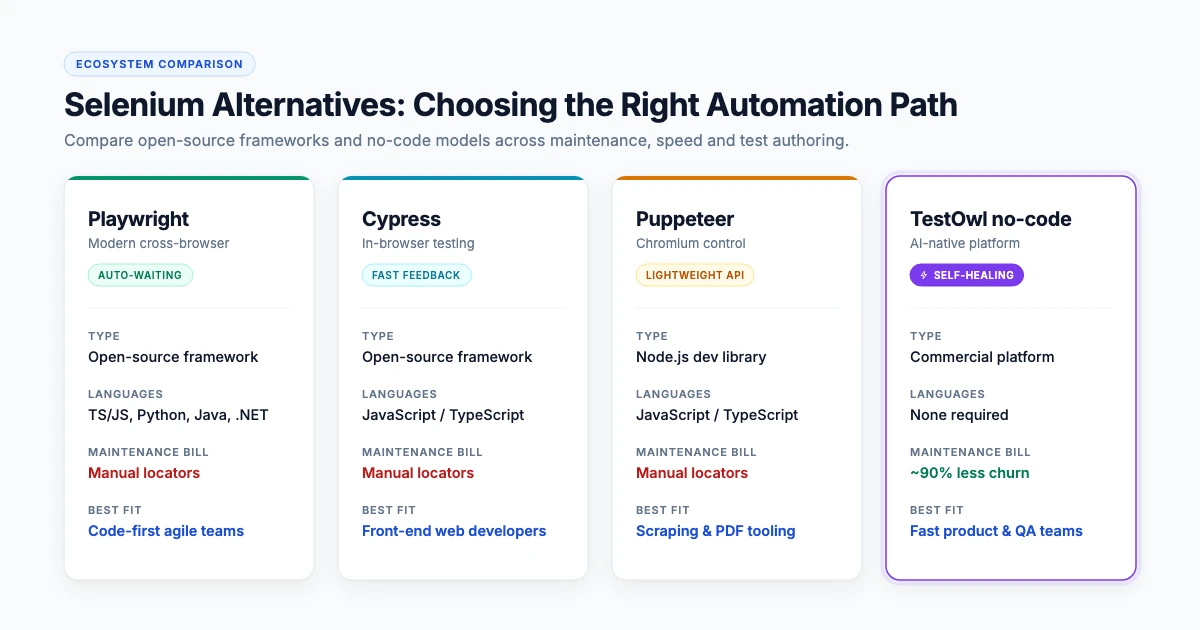
The main alternatives to Selenium are Playwright, Cypress, Puppeteer and no-code test automation platforms. Playwright and Cypress are modern open-source frameworks with faster setup and better debugging; Puppeteer targets Chromium automation; no-code platforms remove the coding and the locator maintenance entirely. Which one fits depends on who writes your tests and how often your UI changes.
Why teams look for a Selenium alternative
Selenium is the reason browser automation exists, it is genuinely free, and it supports more languages and browsers than anything else. The reasons teams still go looking:
Setup and plumbing
Drivers, waits, reporting and CI wiring are yours to build and maintain.
Flakiness from waits
Implicit and explicit waits are a recurring source of false failures.
Locator maintenance
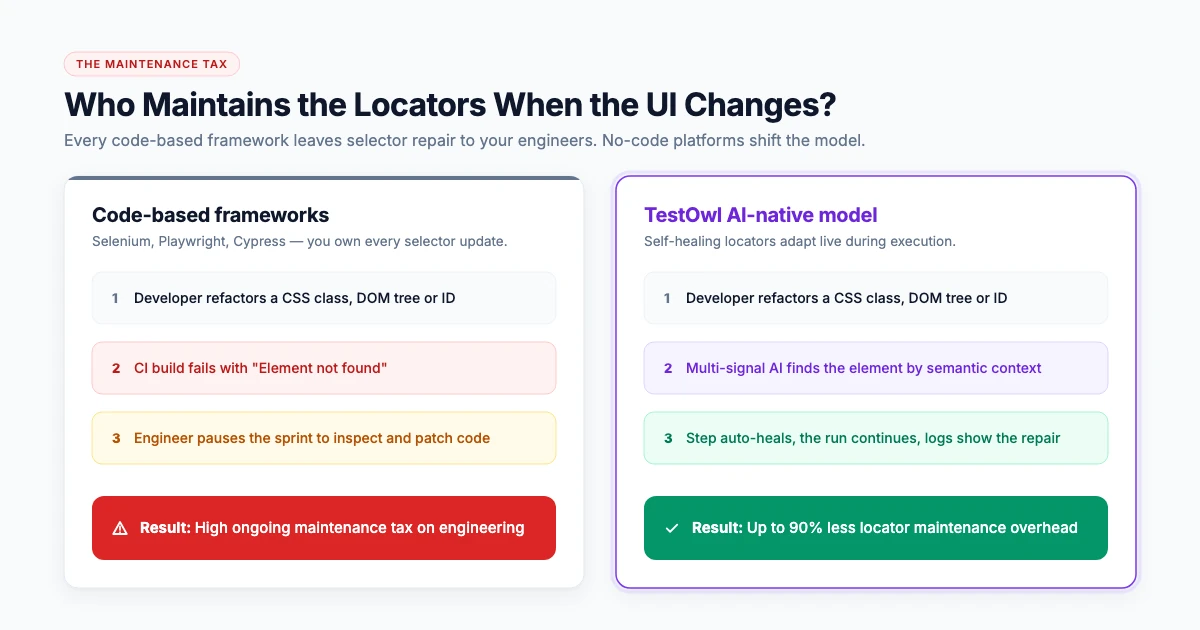
Every UI change means someone updating selectors across test code.
Skill concentration
Only the engineers who know the framework can contribute tests.
Balanced perspective: None of that makes Selenium a bad choice. It makes it a choice with a maintenance bill.
The alternatives compared
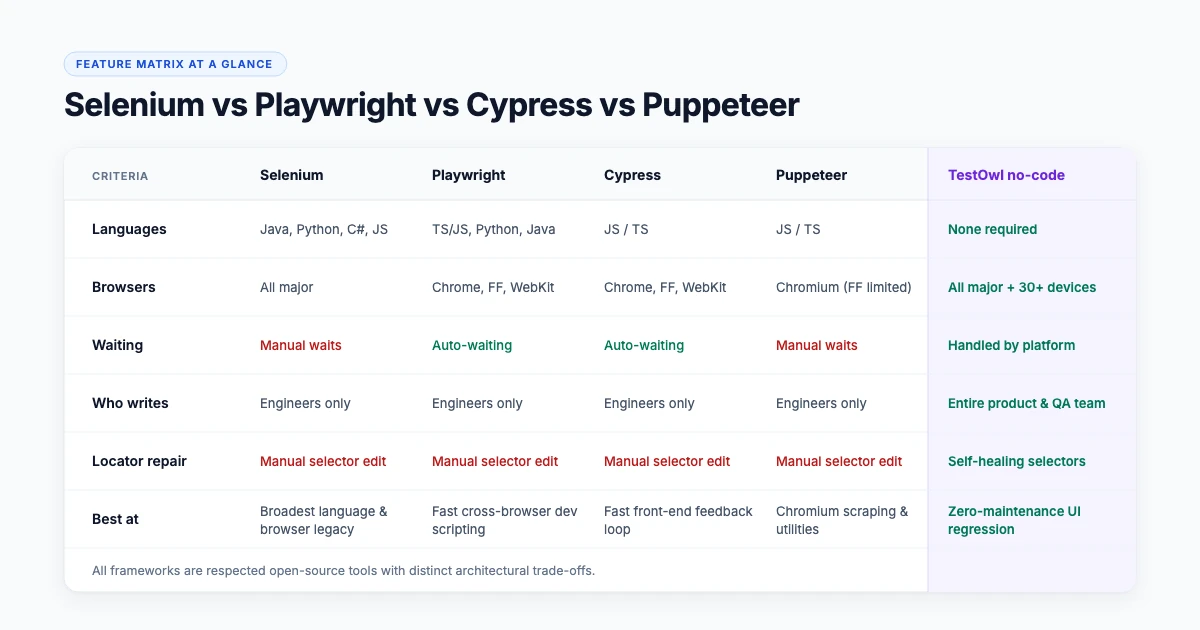
A factual evaluation across languages, browser coverage, waiting mechanisms, authoring personas, and locator maintenance.
| Criteria | Selenium | Playwright | Cypress | Puppeteer | No-code platform |
|---|---|---|---|---|---|
| Type | Open-source framework | Open-source framework | Open-source framework | Open-source library | Commercial platform |
| Languages | Java, Python, C#, JS, Ruby | JS/TS, Python, Java, .NET | JavaScript / TypeScript | JavaScript / TypeScript | None required |
| Browsers | All major | Chromium, Firefox, WebKit | Chromium, Firefox, WebKit | Chromium (Firefox support) | All major, plus devices |
| Setup | Driver and framework work | Quick, batteries included | Quick, opinionated | Minimal, narrow scope | None |
| Waiting | Manual waits | Auto-waiting | Auto-waiting | Manual | Handled by the tool |
| Who can write tests | Engineers | Engineers | Engineers | Engineers | Anyone who knows the product |
| Locator maintenance | Manual | Manual | Manual | Manual | Self-healing |
| Best at | Broadest language and browser support | Modern cross-browser scripting | Fast front-end developer feedback | Chromium scripting and scraping | UI regression that must keep up with releases |
Playwright vs Selenium, briefly
Playwright is newer, ships with auto-waiting, runs Chromium, Firefox and WebKit from one API, and includes tracing that makes failures far easier to diagnose. Selenium has the wider language support, the longer track record, and the W3C WebDriver standard behind it. For a team writing new browser tests in code today, Playwright usually gets to a working suite faster; for a team with a large existing Selenium estate and Java skills, the migration cost is the deciding factor, not the feature list.
Cypress vs Selenium, briefly
Cypress runs inside the browser, which gives developers fast feedback and excellent debugging, and it is opinionated about how tests are written. That design makes some things easy and a few things — multi-tab, multi-origin, non-JavaScript stacks — awkward. Selenium is less opinionated and more flexible, at the cost of more setup.
The other option: stop writing locators at all
Every framework above shares one property: a human writes and maintains the locators. If your bottleneck is maintenance rather than language support, the alternative is not another framework but a different model — record the journey, let the tool keep the locators working, and keep code for the cases that need it.
That is where no-code platforms sit. The trade-off is honest: you give up some low-level control and gain back the time your team spends repairing selectors.
Migrating without stopping releases
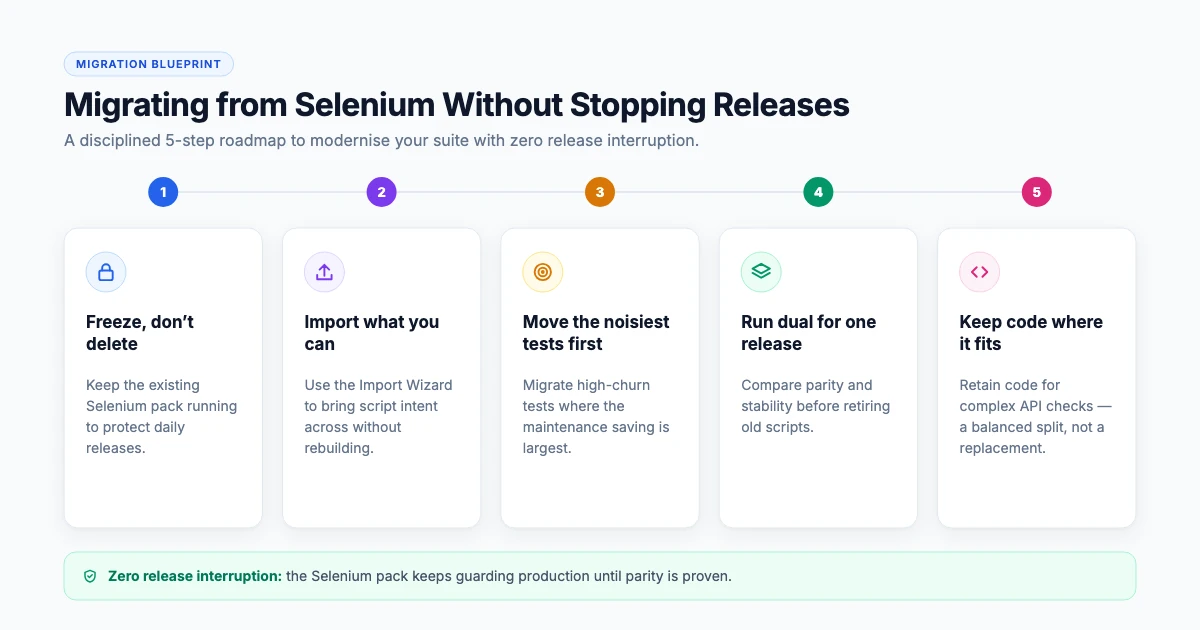
A practical five-step migration plan designed to preserve deployment velocity and build confidence incrementally.
Freeze, do not delete
Keep the existing suite running while you migrate.
Import what you can
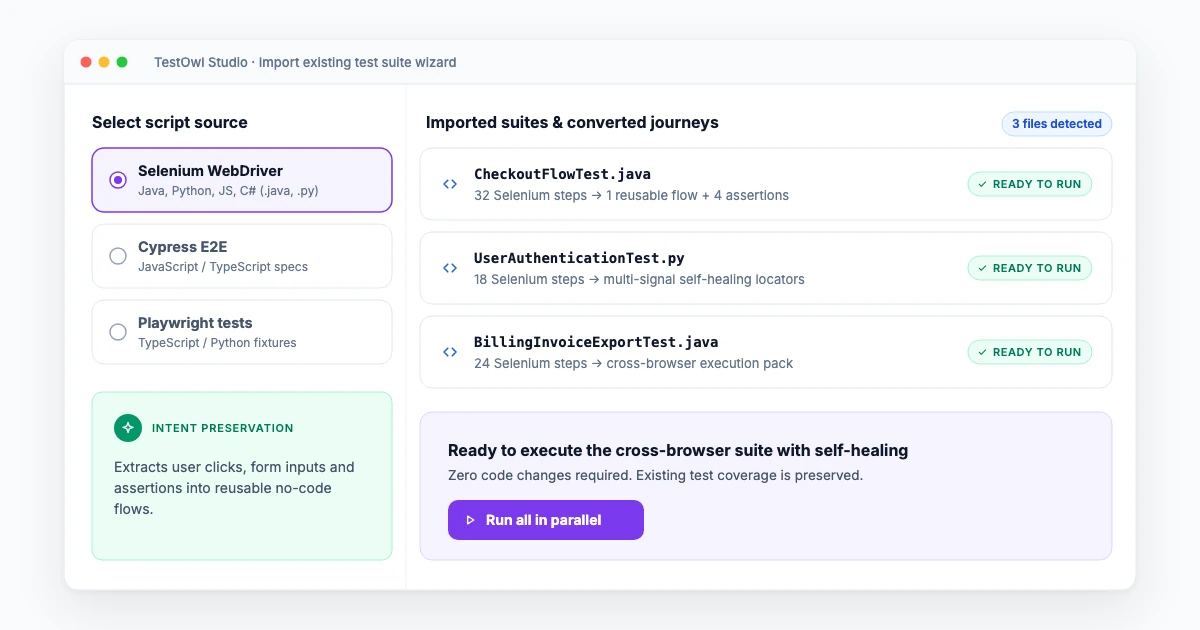
TestOwl imports existing Selenium, Cypress and Playwright scripts, so the journeys do not have to be rebuilt from scratch.
Move the noisiest tests first
The ones that break most often, where the saving is largest.
Run both for one release and compare results
Verify parity and stability before switching over completely.
Keep code-based tests for API-level checks and custom logic
This is a split, not a replacement.
Where TestOwl fits
TestOwl is an AI-native, no-code platform for web application testing. You record a journey once; it runs across Chrome, Firefox, Safari and Edge plus 30+ device profiles, heals locators when the UI changes, and explains the root cause of genuine failures. Shadow DOM, nested iframes, drag-and-drop and data grids are handled natively. Existing Selenium, Cypress and Playwright tests can be imported, and TestOwl runs in the cloud or on-premise.
Validated in your own 4-week pilot
TestOwl's own positioning is up to 10x faster test creation and around 90% less maintenance than hand-written scripts — validate it against your own suite in the 4-week pilot.
Key takeaways
- Playwright, Cypress, Puppeteer and no-code platforms are the real alternatives to Selenium.
- Selenium remains the broadest option for languages and browsers.
- Playwright and Cypress remove setup and waiting problems, not locator maintenance.
- If maintenance is the bottleneck, changing frameworks will not fix it — changing model will.
- Migrate the noisiest tests first, run both suites for one release, and keep code where it earns its place.
Related Solutions & Guides
Explore guides on no-code automation, test evaluation frameworks, and import workflows.
No-Code Test Automation
Build resilient browser tests without writing code by recording user journeys.
Automated Regression Testing
Re-run the journeys that matter on every build without repairing locators.
AI Test Automation Guide
How machine learning turns user recordings into self-healing, maintainable tests.
Buyer’s Guide to Test Automation Tools
Comparison of open-source frameworks, no-code platforms, and cloud test labs.
Official Documentation & Standards
We actively cite and link to the open-source projects we compare.
- Selenium Documentation— Official W3C WebDriver framework and language bindings.
- Playwright Documentation— Microsoft Playwright cross-browser automation library.
- Cypress Documentation— Cypress fast in-browser component and E2E testing.
- Puppeteer Documentation— Google Chrome DevTools Protocol Node.js library.
Frequently Asked Questions
Playwright, Cypress and Puppeteer are the main open-source alternatives, and no-code platforms such as TestOwl are the alternative for teams whose constraint is maintenance rather than language support. The right choice depends on who writes the tests and how often the UI changes.
Playwright offers auto-waiting, one API across Chromium, Firefox and WebKit, and stronger tracing, so new suites usually come together faster. Selenium supports more languages and browsers and follows the W3C WebDriver standard. Neither is universally better.
Cypress runs inside the browser and gives developers fast feedback and strong debugging, with opinionated test structure. Selenium drives the browser from outside, supports more languages and stacks, and is more flexible but needs more setup.
Partly. Test intent transfers even when code does not. Platforms including TestOwl can import existing Selenium, Cypress and Playwright scripts, and the practical approach is to migrate the most frequently broken tests first while the old suite keeps running.
Yes, for teams that need wide language support, non-standard browsers or deep custom control, and that have the engineering time to maintain a framework. The question is not whether it works, but who pays the maintenance bill.
No. They replace them for broad UI regression. Component tests, API-level checks and custom logic remain better in code. Most mature teams run both.