Manual vs Automation Testing
Not a competition — a division of labour. Here is where each one earns its place.
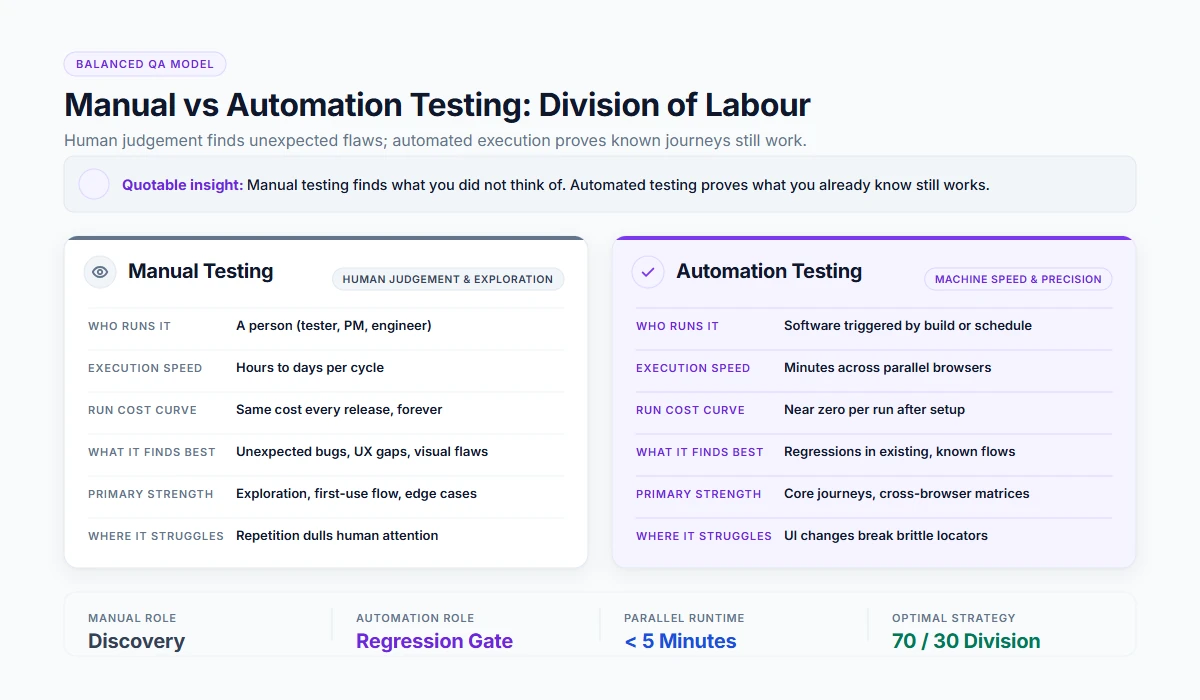
Manual testing is a person using the software and judging the result; automation testing is software running predefined checks and reporting pass or fail. Manual testing is better at judgement, exploration and first impressions. Automation is better at repetition, scale and speed. Teams need both, and the question is which work belongs where.
The differences that actually matter
Rather than asking which methodology is superior, healthy engineering organisations look at how each approach behaves under the pressures of rapid deployment and UI iteration.
| Dimension | Manual testing | Automation testing |
|---|---|---|
| Who runs it | A person | Software, triggered by a build or schedule |
| Cost per run | Same every time | Near zero after it is built |
| Cost to set up | Low | Higher — creation and maintenance |
| Speed | Hours to days | Minutes, in parallel |
| Consistency | Varies with attention | Identical every run |
| Finds | Unexpected problems, usability issues | Regressions in known behaviour |
| Needs | Product knowledge | Product knowledge, plus a tool or code |
| Fails when | Repetition dulls attention | The UI changes and nobody maintains the suite |
Quotable Line
“Manual testing finds what you did not think of. Automated testing proves what you already know still works.”
What should stay manual vs what should be automated
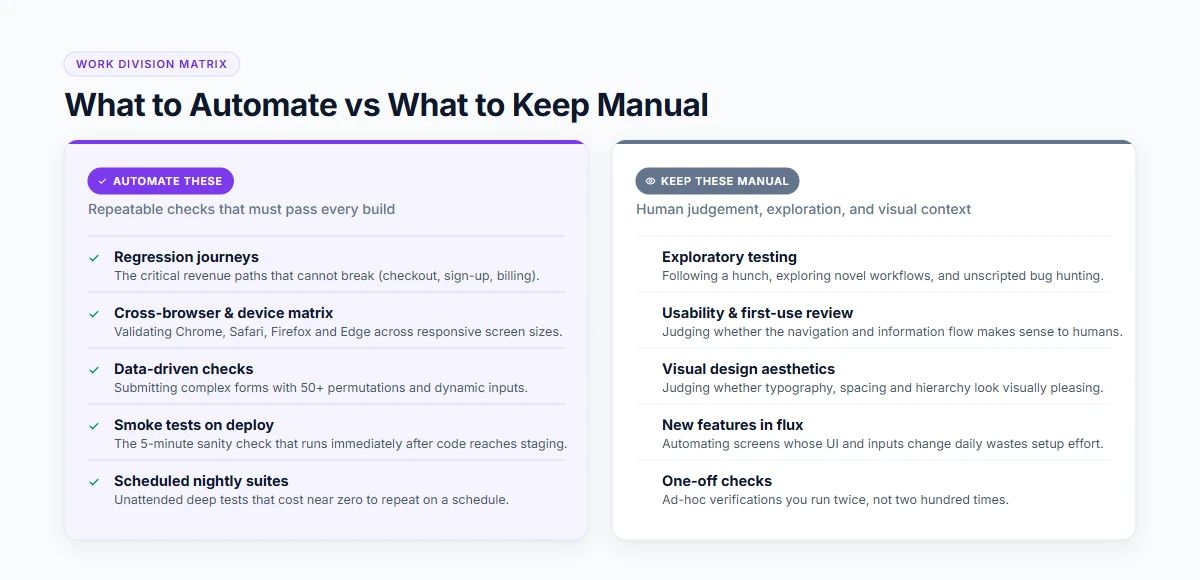
High-performing product teams do not attempt 100% test automation. They draw a deliberate boundary based on whether a task requires human cognitive perception or deterministic verification.
What should stay manual
Tasks where human perception, nuance, and subjective intuition provide the highest return.
- •Exploratory testing. Following a hunch is not a script.
- •Usability and first-use. Whether the flow makes sense to a human.
- •Visual judgement. Whether the layout looks right, not just whether it renders.
- •One-off checks. Anything you will run twice, not two hundred times.
- •New features in flux. Automating a screen that changes daily wastes the effort.
What should be automated
Deterministic, repeatable checks where speed and flawless consistency protect product stability.
- ✓Regression. The journeys that must keep working every release.
- ✓Cross-browser and device checks. The combinations no human has time for.
- ✓Data-driven checks. The same form with fifty input variations.
- ✓Smoke tests. The five-minute check after every deployment.
- ✓Anything repeated on a schedule. Nightly runs cost nothing to repeat.
The economics, honestly
A manual regression pass costs the same every release, forever. An automated pack costs more up front, then very little per run — but it carries a maintenance bill that grows with UI churn. This is the calculation most teams get wrong: they compare creation cost against manual cost and forget maintenance.
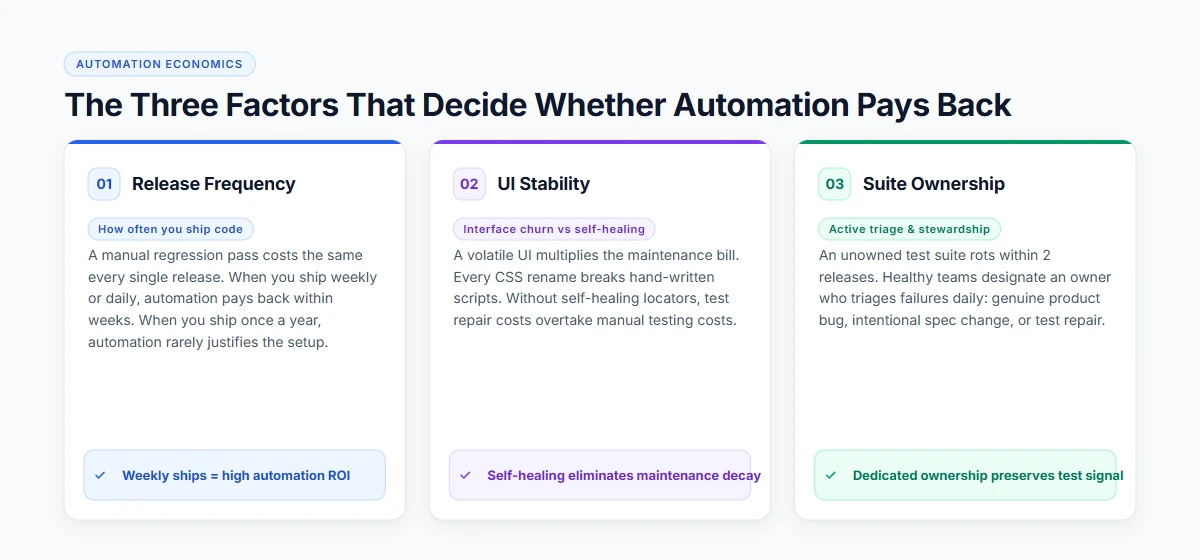
Three factors decide whether automation pays back:
Release frequency
Weekly releases repay automation quickly; annual releases rarely do. High cadence creates the repetition necessary for automated runs to eclipse initial investment.
UI stability
A volatile interface multiplies maintenance — unless the tool heals locators itself. Resilient multi-attribute matching protects ROI from design updates.
Suite ownership
An unowned suite decays, and decayed suites cost more than manual testing. Dedicated triage turns noisy test failures into clear engineering action.
How teams split the work in practice
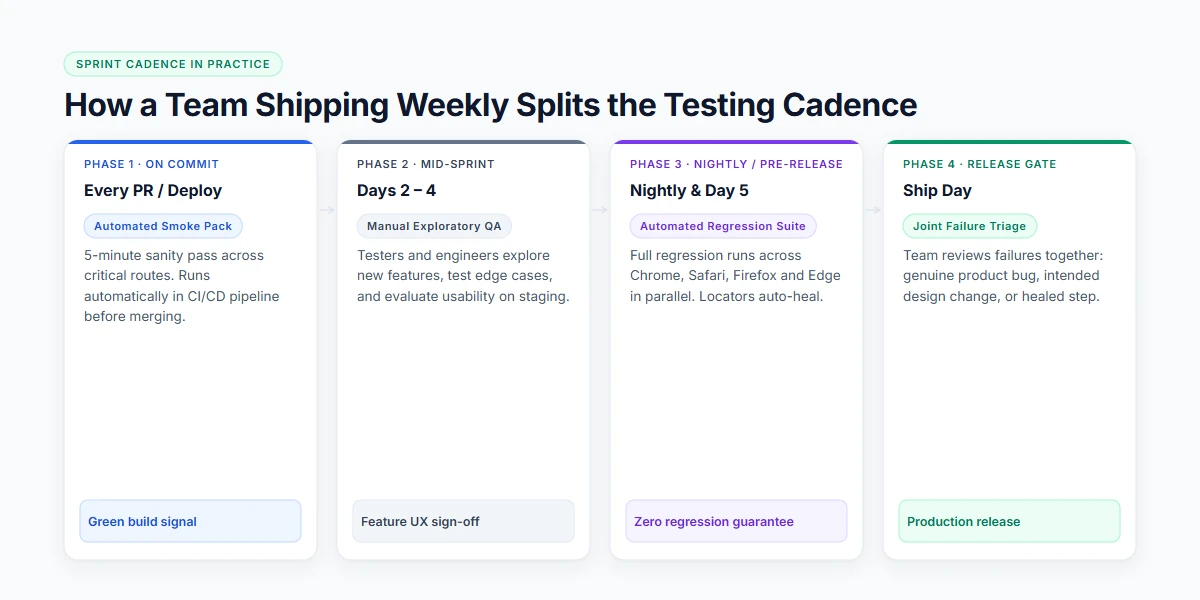
A workable model for an engineering organisation shipping product releases every week or two:
Smoke pack on every deploy, regression pack nightly and before release, cross-browser matrix before release.
Exploratory session on each new feature, usability review, visual check before major releases, and anything involving real payments or customer data.
Failures triaged daily — distinguishing genuine product bugs from changed business expectations or broken locators.
Note what is not in the model: manual regression. That is the repetitive work automation exists to remove.
Does automation replace manual testers?
No — it changes what they do.When regression runs itself, the tester's time moves to exploratory testing, test design, and making sense of failures.
In no-code platforms, the same testers also build the automated tests, because no coding is required. That is usually the fastest route to comprehensive coverage in a team without dedicated automation software engineers.
Where TestOwl fits
TestOwl is aimed at exactly this split. Manual testers record journeys in the browser and TestOwl turns them into resilient tests, so the people with product knowledge build the automation. Tests heal when the UI changes, run in parallel across Chrome, Firefox, Safari and Edge and 30+ device profiles, and report the root cause when something genuinely breaks.
How TestOwl bridges the division of labour:
- Zero code required. Manual testers and domain experts author automation directly in the browser by exercising application workflows.
- Multi-signal self-healing locators. Tests absorb DOM, geometry, class, and text renames between deployments without breaking build pipelines.
- Full multi-browser matrix. Concurrent execution across Chrome, Firefox, Safari, and Edge plus 30+ mobile responsive device viewports.
- Root-cause failure diagnosis. Clear plain-language explanations of genuine application defects rather than cryptic terminal stack traces.
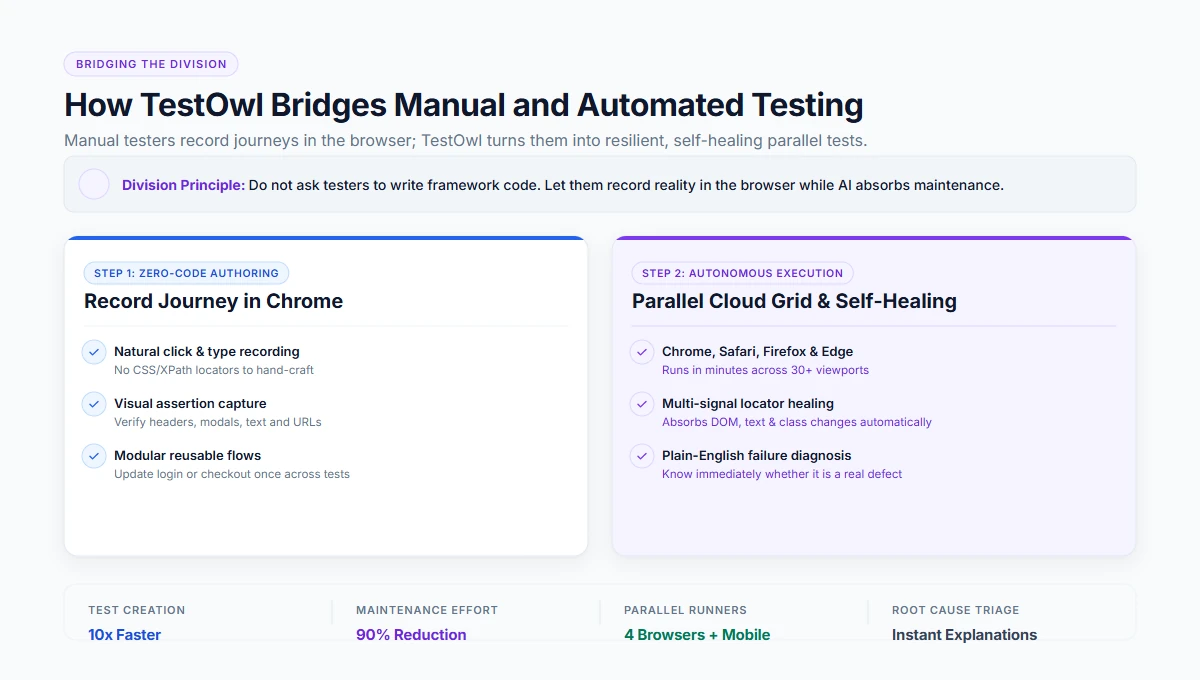
TestOwl's own positioning is up to 10x faster test creation and around 90% less test maintenance compared with hand-written scripts — worth testing against your own manual pack in a pilot.
Key takeaways
- Manual and automated testing answer different questions; both are needed.
- Keep exploration, usability and visual judgement manual.
- Automate regression, cross-browser checks, data-driven checks and smoke tests.
- Maintenance, not creation, decides whether automation pays back.
- Automation moves testers towards exploration; it does not remove them.
Related resources
Frequently Asked Questions
Manual testing is a person using the software and judging the result. Automation testing is software running predefined checks and reporting pass or fail. Manual testing is better at judgement and exploration; automation is better at repetition, scale and speed.
Neither is better in general. Automation wins where checks repeat and have a definite right answer; manual testing wins where judgement is needed. Mature teams automate regression and keep humans for exploratory and usability work.
No. Automation replaces repeated execution of known checks, not test design, exploration or usability judgement. In practice teams that automate regression spend more of their time on exploratory testing.
Yes. Exploratory testing, usability review and test design remain human work, and someone still has to decide what to automate. What is declining is manual execution of the same regression checklist every release.
Not with a no-code platform. Tests are built by recording a journey in the browser, which lets manual testers and product specialists create automation without learning a framework. Code-based frameworks do require programming.
Start with the journeys that would cost money if they broke, then the ones that have broken before, then high-traffic flows. Leave screens under redesign and anything needing human judgement out of the suite.