End-to-End Testing
Test the journey your user actually takes — sign-up to payment — across every system it touches.
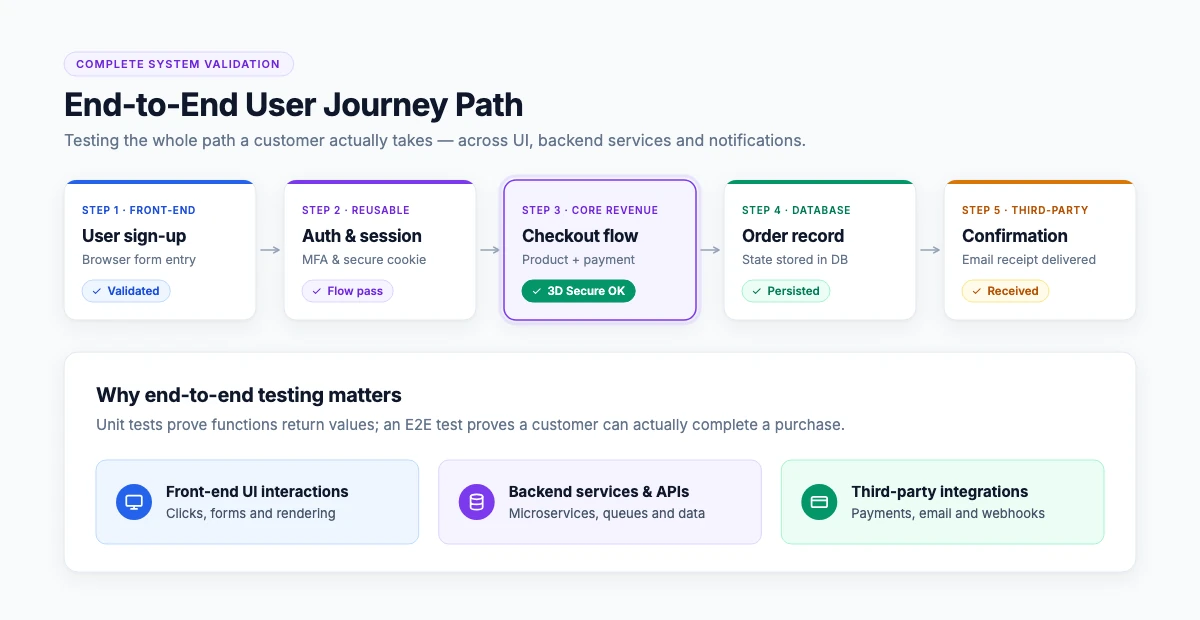
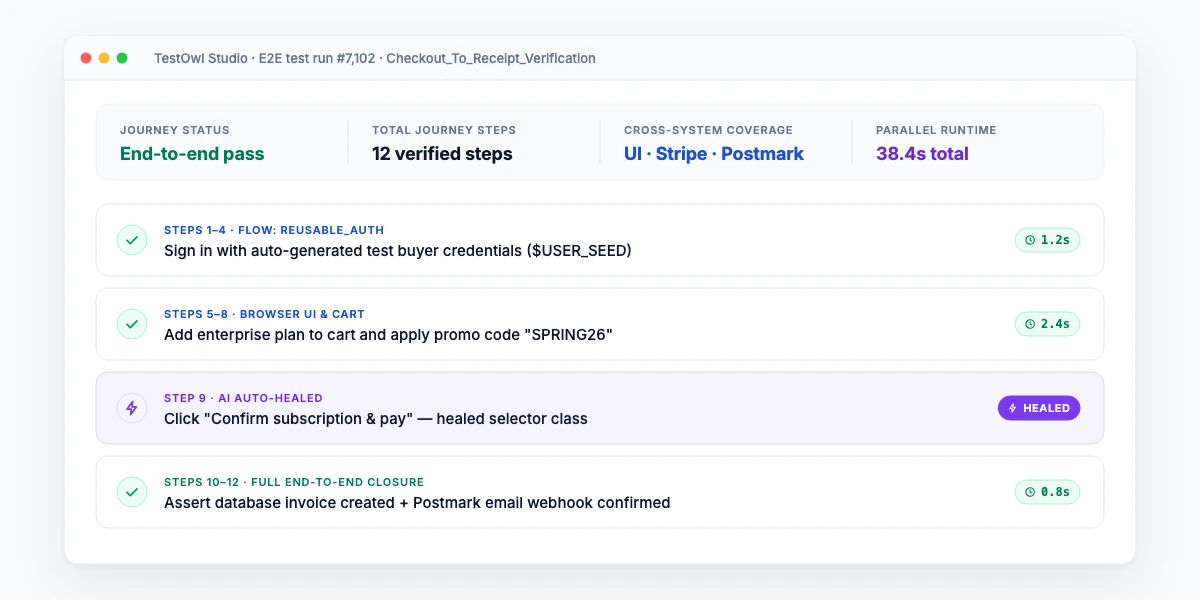
End-to-end testing (E2E)checks a complete user journey from start to finish, across every system it touches. Instead of testing one function in isolation, an E2E test signs up, logs in, completes the workflow and verifies the result — through the UI, the APIs and the database. E2E means “end to end”: the whole path, not one component.
What E2E means
E2E is shorthand for end-to-end. In testing it means the test follows the same path a real user takes, rather than checking one unit of code. A unit test proves a function returns the right value. An E2E test proves a customer can actually buy something.
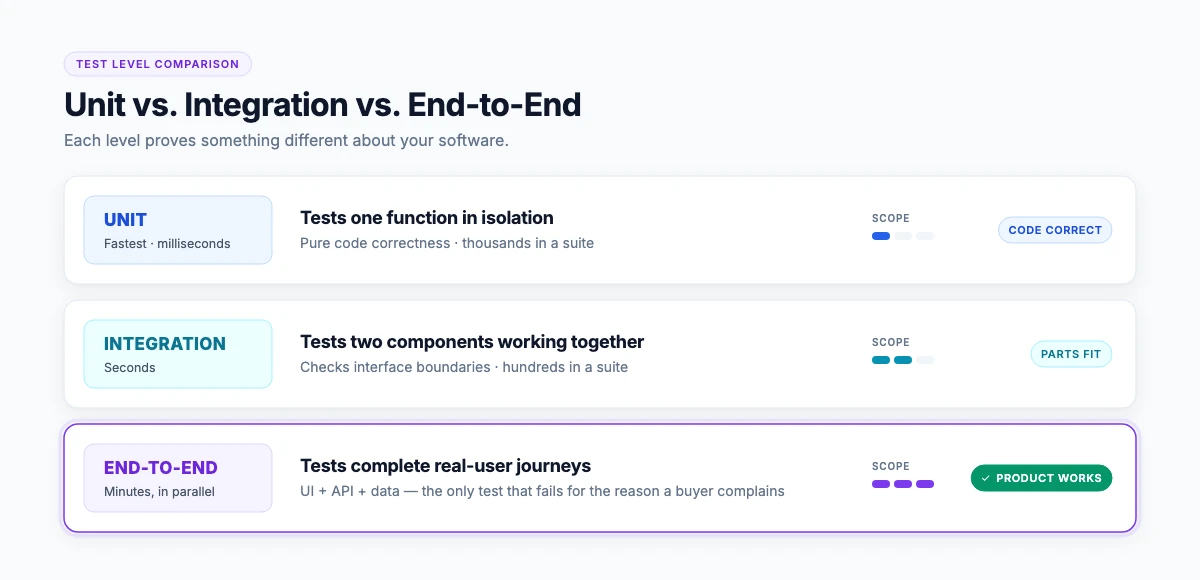
| Level | What it tests | Speed | Confidence it gives |
|---|---|---|---|
| Unit | One function | Milliseconds | The code is correct |
| Integration | Two components together | Seconds | The parts fit |
| End-to-end | A complete user journey | Minutes | The product works |
“An end-to-end test is the only test that fails for the same reason your customer would complain.”
When to use end-to-end tests — and when not to
E2E tests are the most valuable and the most expensive tests you own. Knowing where to draw the boundary makes or breaks your automation ROI.
Use them for
- Revenue journeys: sign-up, checkout, payment, renewal.
- Flows that cross systems: web app to payment provider to email.
- The handful of journeys that must never break.
Do not use them for
- Every permutation of a form.
- Edge cases better covered by unit tests.
- Anything where a cheaper test gives the same information.
The classic guidance still holds — many unit tests, fewer integration tests, a focused set of E2E tests.
Why end-to-end tests are flaky — and how to fix them
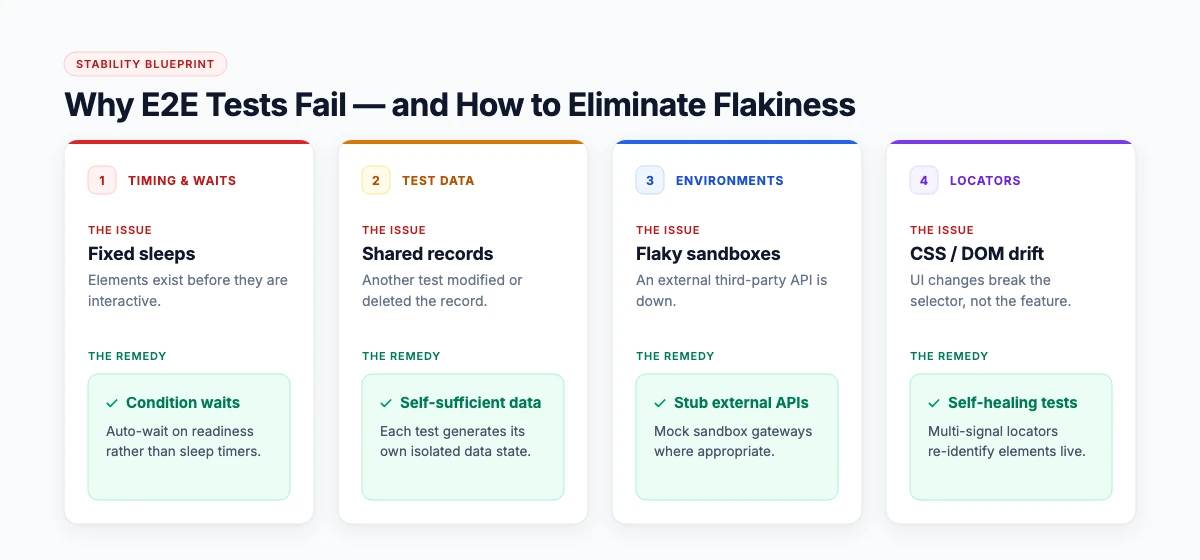
Because they touch everything, they fail for reasons that have nothing to do with the product. Each cause has a direct architectural fix. A flaky E2E suite is a maintenance problem, not an argument against E2E testing.
Timing
Data
Environment
Locators
“A flaky test is worse than no test. It costs developer time every run and teaches the team to ignore failures.”
How to build an end-to-end suite that survives releases
A pattern that prevents suites decaying within three months:
Start with five journeys, not fifty
The five that would cost money if they broke.
Make each test self-sufficient
It creates the data it needs and cleans up afterwards.
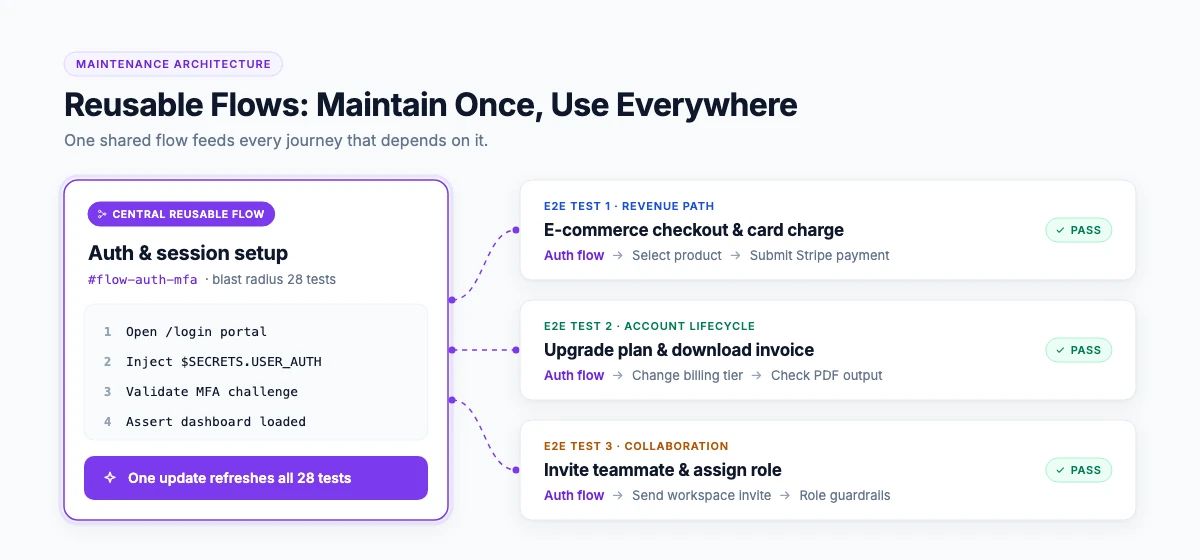
Use reusable steps for shared parts
Keep common flows like login in one place, so one change is one edit.
Assert what the user sees, plus one check behind the scenes
Verify the user confirmation, plus one check where it matters.
Run in parallel and on every build
Avoid overnight batch runs that delay feedback.
Quarantine flaky tests immediately
Fix or delete within a sprint. A suite people ignore is worse than no suite.
Where TestOwl fits
TestOwl is built specifically for end-to-end journeys that are painful in conventional frameworks:
- Reusable Flows for shared parts of a journey, maintained in one place.
- Self-healing steps so a UI change does not break the whole journey.
- Root-cause reporting that separates a timing problem from a product bug.
- Test data generation and encrypted Secrets so tests are not tied to one record or to plain-text credentials.
- Hard components handled natively — Shadow DOM, nested iframes, drag-and-drop, data grids.
Start with your one journey that matters most — sign-up or checkout. Automate that in TestOwl, run it on your next release, and see how much maintenance it needs compared to your existing suite.
Key takeaways
- E2E means end to end: the full user journey, across every system it touches.
- E2E tests give the most confidence per test and cost the most to maintain.
- Keep the set small and revenue-focused.
- Flakiness comes from timing, data, environments and locators — all fixable.
- Quarantine flaky tests fast; a suite nobody trusts is worse than none.
Related Solutions & Guides
Explore connected topics in test levels, regression pipelines, and self-healing automation.
Automated Regression Testing
Re-run the journeys that matter on every build without locator repair overhead.
Web Application Testing
What to test in a web app before every release across browsers and dynamic components.
No-Code Test Automation
Author resilient browser tests through intelligent recording and visual workflows.
AI Test Automation Guide
How machine learning turns user recordings into self-healing, maintainable tests.
Standards & Documentation
- Martin Fowler: Practical Test Pyramid— Foundational architectural guide on balancing unit, integration, and UI end-to-end tests.
- TestOwl Documentation: Reusable Flows— How to build shared sub-flows and parameterized steps across end-to-end suites.
Frequently Asked Questions
End-to-end testing checks a complete user journey from start to finish across every system it touches — the interface, the APIs and the data behind them. It verifies that the product works as a whole, rather than that one function returns the right value.
E2E is an abbreviation of "end to end". In software testing it describes a test that follows a full user journey rather than one isolated component, so a single test can cover the browser, the backend services and any third parties involved.
Integration testing checks that two or more components work together. End-to-end testing runs a complete user journey through the whole system. Integration tests are faster and narrower; E2E tests are slower and give the most realistic confidence.
Fewer than you think. Cover the journeys that would cost money or trust if they broke — typically five to twenty for a mid-sized product — and use unit and integration tests for the rest.
Because they depend on timing, test data, environments and third parties. Condition-based waits, self-created test data, stubbed third parties and self-healing locators remove most of the flakiness.
Yes. No-code platforms record the journey in the browser and turn it into a structured, re-runnable test, which is how teams without automation engineers keep an E2E suite running.